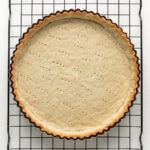
Gluten-Free Shortcrust Pastry
Create delicious gluten-free tarts with this easy-to-make gluten-free shortcrust pastry recipe. Enjoy the buttery taste and sturdy texture.
Servings 8
Calories 121kcal
Equipment
- 9" Tart Pan (1" high) with removable bottom
Ingredients
Instructions
Make The Dough
- Combine the dry ingredients. To a food processor, add the gluten-free flour, sugar, and salt. Pulse 10 times to combine.
- Add the cold butter. Cut the butter into chunks and add it to the food processor. Pulse around 15-20 times, or until the mixture resembles coarse crumbs.
- Add the beaten egg. In a small bowl beat the egg with a fork then and add it to the flour mixture. Run the food processor for 15-20 seconds or until the dough starts to come together.
- Chill the dough. Transfer the dough to a large sheet of plastic wrap. Use the wrap to help bring it all together and form it into a disk. Refrigerate for 2 hours or up to 2 days.
Roll Out The Dough
- Remove the dough from the refrigerator. Let the dough rest at room temperature for 15 minutes. After 15 minutes, place the dough on a piece of floured parchment paper. Using a rolling pin, pound out the middle a few times to flatten the dough while lifting and rotating. If the dough starts to crack, gently push it back together. Place another piece of parchment paper on top.
- Roll out the dough. Gluten-free dough can be sticky so I recommend rolling it out between 2 large pieces of parchment or plastic wrap. This makes it much easier to roll and transfer to the pan. Start in the center and roll outward, rotating 90 degrees every few rolls. Roll the dough to ¼" thick and about 10-11" wide. Remove the top layer of parchment paper and brush off any excess flour.
- Transfer the dough to the pan. Place one hand under the remaining parchment paper and carefully flip the dough over the top of the pan. Peel off the remaining parchment paper. Gently lift the edges of the dough to drop it to the bottom of the pan.
- Form the dough into the pan. Using light pressure, press the dough into the pan. If it tears, just patch it back together. You can also add a little flour to the bottom of a measuring cup and gently push the cup along the edges and center to help flatten the dough.
- Trim the excess pastry. Gently press the dough against the sides of the pan. Run a sharp knife around the edges of the pan to trim any excess dough. Use the excess pieces of dough to cover any visible spots.
- Dock and freeze. Using a fork, dock the shortcrust pastry in several places. Cover the pastry with plastic wrap and place it in the freezer for 30 minutes. If using this crust with a filling that bakes in the shell, follow the instructions in the tart recipe. If using a no-bake filling, follow the instructions below for blind-baking the crust.
Blind Bake
- Prepare the crust for blind baking. Preheat the oven to 425°F. Crumple up a piece of parchment and place it in the center of the dough. Make sure to cover the edges to prevent the pastry crust from burning. Top with pie weights or dried beans. The weights will help the crust to keep its shape while baking. before removing it, then transfer the shell to a wire rack to continue cooling.
- Blind bake and let cool. Place the tart pan on a baking sheet and into the preheated oven for 20 minutes. The edges of the crust should just be starting to brown. Remove the parchment and pie weights. Place the tart back in the oven to bake for another 5 minutes or until it is lightly browned. Allow the shell to cool in the pan for at least 20 minutes
Notes
Tips
- Make sure to chill the dough for at least 2 hours.
- Roll the dough in between two pieces of floured parchment paper. If it does start to tear when transferring to your tart pan, that's ok!
- This pastry is very forgivable, so just ease it into the pan the best you can and cover up any patches with the excess handover as needed. You can also roll the pastry back into a ball of dough, flatten it back into a disk, and place it back in the refrigerator.
Nutrition
Serving: 1 serving | Calories: 121kcal | Carbohydrates: 3g | Protein: 1g | Fat: 12g | Saturated Fat: 7g | Polyunsaturated Fat: 1g | Monounsaturated Fat: 3g | Trans Fat: 0.5g | Cholesterol: 53mg | Sodium: 156mg | Potassium: 12mg | Fiber: 0.01g | Sugar: 3g | Vitamin A: 384IU | Calcium: 7mg | Iron: 0.1mg